
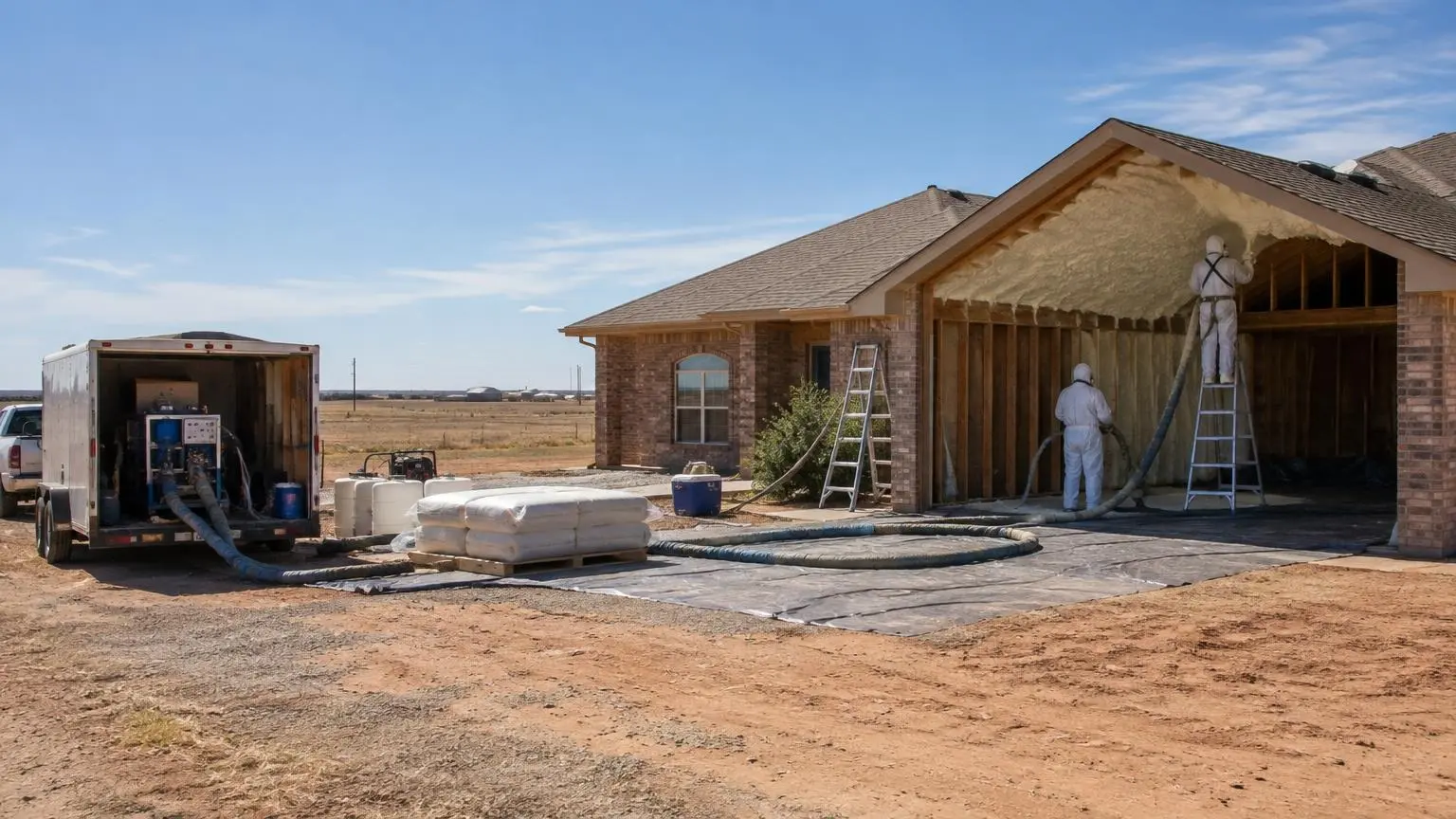
Open-cell and closed-cell foam
Spray Foam Insulation in Lubbock, TX
The right foam for each surface: open-cell where air sealing and sound matter, closed-cell where steel, tight cavities or moisture call for it.
- Free on-site estimates
- Written quotes that name foam type, thickness and R-value
- Attic ducts, roof leaks and old insulation checked before we spray
Choosing Between Two Kinds of Foam
Spray foam insulation goes on as a liquid, swells to fill every crack and cures in place, so it insulates and air seals in a single pass. That double job is why it suits Lubbock, where the wind averages 12.4 mph and an attic can sit far above the outdoor temperature on a July afternoon. Before we price anything, we decide which of the two foams fits each part of the building.
Open cell vs closed cell
Open-cell foam is spongy and light. It expands many times its liquid volume, fills irregular cavities around wiring and framing, and blocks air movement and sound. HomeGuide puts it at R-3.5 to R-3.7 per inch, and it is the lower-cost option per square foot. Water vapor can pass through it, which is usually fine in a dry climate as long as there is no leak feeding it water.
Closed-cell foam is hard and dense. HomeGuide rates it at R-5 to R-7 per inch, so it reaches a given R-value in less depth. It slows vapor, resists water and stiffens the surface it bonds to. It costs more per square foot, and it is the foam we use on steel buildings, in thin cavities, and anywhere condensation on a cold surface is the problem.
Where we use foam in a South Plains house
The most common foam job in Lubbock homes is the underside of the roof deck. When the air handler and ducts are in the attic, foaming the roofline and gable walls pulls that equipment inside the insulated shell, so it is no longer working in attic heat. Open-cell foam is the usual choice there, sprayed to the depth the target R-value calls for.
We also foam exterior wall cavities in additions and remodels, cathedral and vaulted ceilings with no attic above them, bonus rooms over garages, and the knee walls and floors around upstairs rooms. In new construction we spray open stud bays before drywall.
What the code numbers mean for foam depth
The City of Lubbock's 2024 energy code ordinance lists R-38 for ceilings and R-13 for wood-frame walls in new work. At R-3.5 to R-3.7 per inch, open-cell needs roughly 10 inches or more to approach R-38, while a 2x4 wall cavity filled with open-cell lands well above R-13. Closed-cell reaches high R-values in fewer inches, which matters in rafters and shallow framing. We write the planned thickness and the resulting R-value on every quote so you can compare bids on equal terms.
What spray foam will not fix
Foam is not a roof. If shingles, flashing or a pipe are leaking, that has to be repaired first or the foam will hide wet wood. Foam is also not always the cheapest way to insulate a wide attic floor; sealing the leaks and blowing in cellulose or fiberglass to depth often costs less. And we do not cover old wiring, damaged framing or suspect materials until they have been checked.
Prep, spraying and getting back in
Spraying is quick; prep takes longer. We cover floors and belongings, mask outlets and windows, and ventilate the space. HomeGuide advises staying out for 24 hours or more while the foam cures. For a detached shop the household may not need to leave at all. Once cured, foam does not settle, so the depth we leave is the depth you keep.
Tell us which spaces you are thinking about and what bothers you: a hot room, high bills, dust or dripping steel. We will look, explain where foam pays and where it does not, and send a written price. Get a free estimate
Where Spray Foam Goes
The places we spray most often and the foam we usually choose.
Open-cell foam
Light foam at R-3.5 to R-3.7 per inch (HomeGuide) that seals air and quiets sound; common under roof decks and in wall cavities.
Closed-cell foam
Dense foam at R-5 to R-7 per inch (HomeGuide) that slows vapor; used on steel, in thin cavities and where condensation is a risk.
Roof deck and gable walls
Foam under the roof sheathing to bring attic ducts and the air handler inside the insulated shell.
Exterior walls
Open stud bays in new construction, additions and remodels, sized to the wall target.
Vaulted ceilings and bonus rooms
Ceilings that follow the roof and rooms over garages where batts leave gaps.
Metal buildings
Closed-cell on panels and purlins in shops and barns to insulate and stop dripping.
Published Spray Foam Insulation Costs
| Job | Range and source |
|---|---|
| Spray foam, installed | $1.50 to $5.00 per sq ft (HomeGuide) |
| Open-cell / closed-cell | $1.50 to $3.50 / $3.00 to $5.00 per sq ft (HomeGuide) |
| Roughly 1,000 sq ft | $1,500 to $5,000 (HomeGuide); $3,150 to $7,500 existing home (Fixr) |
| Existing walls / new construction | $3.15 to $7.50 / $2.75 to $6.50 per sq ft (Fixr) |
| Attic | $3,000 to $8,000 (HomeGuide); $2,500 to $12,000 existing home (Fixr) |
| Whole house | $8,000 to $20,000 (HomeGuide); $10,000 to $30,000 (Fixr) |
| Common job minimum | $1,000 to $2,000+ (HomeGuide) |
National ranges from HomeGuide's 2026 spray foam guide and Fixr's 2025 guide, not Lubbock quotes. Foam type, depth, access and prep change the total, and small jobs often hit a minimum. You pay the amount written on our estimate.
How a Spray Foam Job Runs
1. Visit and measure
We inspect each space, look for leaks, damp wood and old wiring, and take measurements.
2. Written quote
Each area lists foam type, thickness, target R-value and price.
3. Prep
We cover, mask and set up ventilation, and confirm the space is ready to spray.
4. Spray and trim
Foam goes on in passes to the planned depth and is trimmed where needed.
5. Cleanup and walk-through
We clean up, show you the work and tell you when you can use the space again.

Why Choose Us for Spray Foam Insulation
Foam only where it pays
If loose fill or air sealing gets the result for less in part of the house, we say so.
Thickness on paper
Depth and R-value are written per area so you can compare bids fairly.
Leaks found first
Roof leaks, damp framing and wiring concerns are pointed out before anything is covered.
Spray Foam Insulation Questions
Is open-cell foam enough for a Lubbock attic?
Usually, when it is sprayed deep enough under the roof deck and there is no leak. It seals air well and costs less than closed-cell. We size the depth to the R-value target and write both on the quote.
How long should we stay out after spraying?
HomeGuide advises 24 hours or more. For a detached shop or barn, the household may not need to leave. We confirm timing for your job.
Will spray foam make my house too tight?
A tighter house is the goal, but fuel-burning appliances and fresh air still need attention. We look at water heaters, furnaces and bath fans on the visit and tell you if anything needs a change.
Can spray foam stop dust coming in?
It helps a lot. Dust enters where outside air leaks in, and foam fills those leaks in the same layer that insulates.
Spray Foam Insulation Service Areas
- Spray Foam Insulation in Lubbock, TX
- Spray Foam Insulation in Wolfforth, TX
- Spray Foam Insulation in Shallowater, TX
- Spray Foam Insulation in Idalou, TX
- Spray Foam Insulation in Slaton, TX
- Spray Foam Insulation in Ransom Canyon, TX
- Spray Foam Insulation in Abernathy, TX
- Spray Foam Insulation in New Deal, TX
- Spray Foam Insulation in Lorenzo, TX
- Spray Foam Insulation in Ralls, TX
- Spray Foam Insulation in Levelland, TX
- Spray Foam Insulation in Littlefield, TX
- Spray Foam Insulation in Brownfield, TX
- Spray Foam Insulation in Tahoka, TX
- Spray Foam Insulation in Post, TX
Get a Spray Foam Insulation Estimate
Tell us the spaces and what you have noticed. We will look and send a written foam plan and price.