
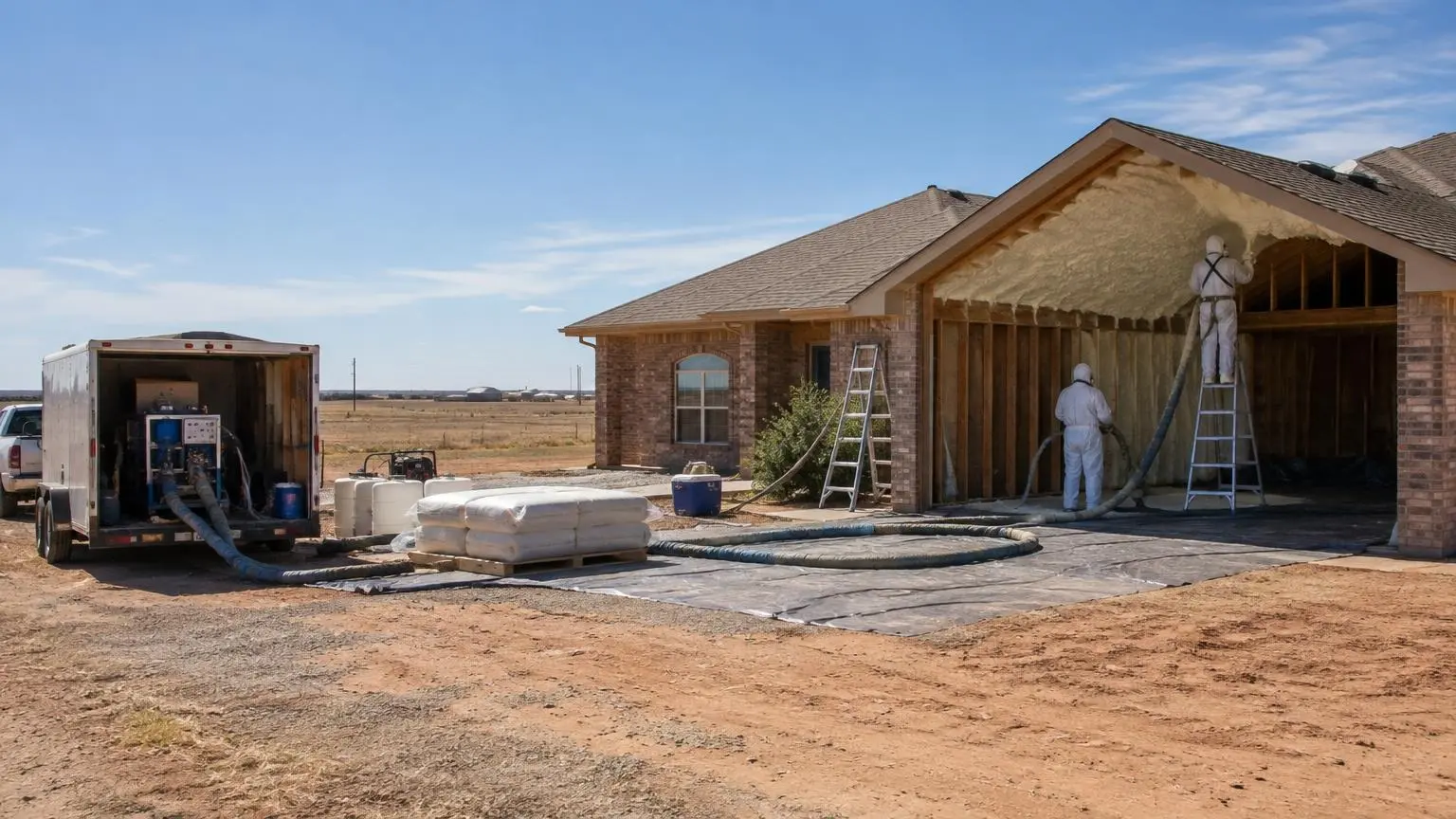
New construction, additions and existing walls
Wall Insulation in Lubbock, TX
Fill the cavities and seal the gaps so the wind stays outside and the rooms hold their temperature.
- Free on-site estimates
- Written quotes that name foam type, thickness and R-value
- Attic ducts, roof leaks and old insulation checked before we spray
Walls That Block Wind as Well as Heat
Wall insulation matters more in Lubbock than many people expect. With an average wind speed of 12.4 mph, outside air presses on the walls most days of the year, and it finds its way in around outlets, windows, sill plates and wiring holes. Insulation that fills the whole cavity and seals those paths makes rooms quieter, less drafty and easier to keep at temperature. We insulate walls in new construction, additions and remodels, and in existing homes where the cavities are empty or thin.
New construction and open walls
When the studs are open, spray foam is the most complete option. Open-cell foam expands into every corner of the bay, around boxes and pipes, and seals the framing joints in the same pass. The City of Lubbock's 2024 energy code ordinance lists R-13 for wood-frame walls; at R-3.5 to R-3.7 per inch in HomeGuide's figures, a full 2x4 bay of open-cell exceeds that. Closed-cell can be used where a wall needs more R-value per inch or added stiffness. We coordinate with builders so foam goes in after rough-in inspections and before drywall.
Existing walls
In a finished house, opening the walls is rarely worth it just for insulation. Instead, closed cavities can be filled with dense-pack cellulose or fiberglass blown in through small holes, which are then patched. HomeGuide lists dense-pack cellulose at $1.60 to $4.20 per square foot. Before drilling, we check for blocking, wiring and existing insulation so we know each bay will fill. If you are already replacing siding or opening walls in a remodel, that is the moment to consider foam.
Why sealing the wall counts
ENERGY STAR's retrofit guidance says that when siding comes off an uninsulated wood-frame wall in Zone 3, the cavity should be filled and R-5 of insulating sheathing added under the new siding. That pairing of full cavities and a continuous layer is the same idea we follow inside: fill the bay and stop air at the edges, where most of the leakage happens.
Brick and older homes
Many houses on the South Plains have brick veneer over a framed wall. The air space behind the brick is meant to stay open, so insulation goes in the stud cavity, not behind the brick. In older frame homes we look for knob-and-tube wiring and balloon framing before blowing anything in, because both change the plan.
Sound and comfort
Open-cell foam and dense-pack both reduce sound between rooms and from the street. Interior walls around bedrooms, home offices and media rooms are a common add-on during a remodel.
Tell us whether the walls are open or finished and what the house is built from. We will look and send a written price. Get a free estimate
Wall Insulation Options
What we install, depending on whether the walls are open or closed.
Open-cell foam in stud bays
Fills and seals open cavities in new homes, additions and gut remodels.
Closed-cell foam in walls
Higher R-value per inch where space is tight or more stiffness is wanted.
Dense-pack cellulose
Blown into closed walls through small holes that are patched afterward.
Blown fiberglass in walls
An alternative fill for closed cavities where it suits the wall.
Interior sound walls
Insulating walls around bedrooms, offices and media rooms.
Rim and band areas
Sealing the edges of floors and walls where framing meets the foundation.
Published Wall Insulation Costs
| Job | Range and source |
|---|---|
| Spray foam, existing walls | $3.15 to $7.50 per sq ft (Fixr) |
| Spray foam, new construction | $2.75 to $6.50 per sq ft (Fixr) |
| Spray foam, all exterior walls | $4,000 to $10,000 (HomeGuide) |
| Blown-in, exterior walls | $1,900 to $7,800, $1.10 to $3.70 per sq ft (HomeGuide); $2,000 to $4,000 (Fixr) |
| Dense-pack cellulose | $1.60 to $4.20 per sq ft (HomeGuide) |
National ranges from HomeGuide (2026 spray foam guide, Nov 2025 blown-in guide) and Fixr (2025). Wall height, access, siding type and patching change the total. The written estimate we give you is the price.
How Wall Insulation Is Done
1. Check the walls
We look at framing, wiring and existing insulation, open or closed.
2. Quote
Material, depth, R-value and price, per wall area.
3. Prep
Open walls are masked; closed walls are marked for drilling.
4. Install
Foam is sprayed and trimmed, or loose fill is blown to density.
5. Finish
Holes are plugged and patched, and the site is cleaned.
Why Choose Us for Wall Insulation
Builder-friendly scheduling
We work around inspections and drywall dates.
Checked before drilling
Wiring and blocking are found before we fill closed walls.
R-value per wall
The quote shows what each wall gets.
Wall Insulation Questions
Can you insulate walls without removing drywall?
Yes. Dense-pack cellulose or fiberglass is blown in through small holes, then the holes are plugged and patched.
What R-value do Lubbock walls need?
The City of Lubbock's 2024 energy code ordinance lists R-13 for wood-frame walls in new work. A full 2x4 cavity of open-cell foam exceeds that.
Is foam or dense-pack better for existing walls?
Foam is best when the walls are open. In finished walls, dense-pack is usually the practical choice because it does not require opening the wall.
Does wall insulation help with noise?
Yes. Filling cavities with foam or dense-pack reduces sound passing through walls.
Wall Insulation Service Areas
- Spray Foam Insulation in Lubbock, TX
- Spray Foam Insulation in Wolfforth, TX
- Spray Foam Insulation in Shallowater, TX
- Spray Foam Insulation in Idalou, TX
- Spray Foam Insulation in Slaton, TX
- Spray Foam Insulation in Ransom Canyon, TX
- Spray Foam Insulation in Abernathy, TX
- Spray Foam Insulation in New Deal, TX
- Spray Foam Insulation in Lorenzo, TX
- Spray Foam Insulation in Ralls, TX
- Spray Foam Insulation in Levelland, TX
- Spray Foam Insulation in Littlefield, TX
- Spray Foam Insulation in Brownfield, TX
- Spray Foam Insulation in Tahoka, TX
- Spray Foam Insulation in Post, TX
Get a Wall Insulation Estimate
Tell us if the walls are open or finished. We will look and send a written price.